





In the past decade alone, India has seen massive scale and diversity in the beauty category. With increasing access to smartphones and the internet, global trends now reach the Indian consumer in a steady stream as opposed to the trickle of yesteryear. There’s been a marked spike in both awareness and adoption, and we’re seeing that play out in different ways. There’s been a noticeable boom in the quantum of social media influencers & content in the category. Offline, we see more and larger cosmetics counters at department stores. And one can’t ignore the massive spurt of homegrown D2C brands in the beauty and personal care spaces.
Who we are
It’s safe to presume that the entirety of the Indian beauty consumer base would display a far wider range of behaviours and patterns.
Working with several beauty brands over the past 4 years piqued our curiosity about the category and consumer, and to put it simply, we had questions.
So many questions, So little time.
Fascinated by some of the beauty data & content emerging from smaller towns across India, we wanted to delve into the lives of some of these consumers to understand their relationship with the category. And boy, did we learn a lot – and unlearn even more.
The following report captures some of our learnings, observations and anecdotes from these 'beautiful strangers'.
Meet MiMi
We
set forth on this exploration to see how consumers from certain regions
across India discovered and consumed beauty. We focused our attention
on an audience that could offer us perspectives that we weren’t
otherwise privy to. From beauty vlogs to deep conversations and
ethnographic market visits, we sifted through them all to better
understand our consumers' beauty attitudes and behaviours.
We
spent time considering which segment we wanted to study. We made sure to
pick cities that represented growing beauty consumption, both online
and offline, across different geographies within the country. Moreover,
we identified ones that aren’t satellites to metros, so as to not simply
reflect big-city behaviours. In true Goldilocks fashion, they had to be
“just right.” To that end, we identified 6 markets that fit the bill :

Who we are
We also wanted to understand the behaviour of consumers who were still early in their journey, to avoid biases of long-standing traditions or habits.

What makes up MiMi's Mind?
As we spent time speaking to the MiMi cohort and understanding their relationship with beauty, certain patterns emerged. Here are some of the common trends we noticed that influence MiMi's journey into beauty.

1.
The Societal Make-up
Societal
norms and guidelines play a considerable role in the adoption of beauty
products in these markets. Smaller cities, spared from the bustle of
city life, have a far more closely woven social fabric – one in which
each individual yarn is both noticed and important. Neighbourhoods are a
collective, with a strong sense of community and social identity.
In social constructs such as these, we’ve found that the sense of belonging is integral for each individual.
For
instance, the overarching narrative that “Make-up is only for
grown-ups” discourages young women from truly incorporating it into
their lives before the age of 18. While they might experiment in the
privacy of their home, and even consume a great deal of beauty content,
the MiMi is conscious of the impact her choices have upon the overall
social standing and acceptance of herself and her family.
Makeup
is not exactly viewed as taboo within this society. But the MiMi, just
entering adulthood and embracing her own identity vis-a-vis the
category, must navigate her debut mindfully. It isn’t uncommon to be
chided by one’s elders about the frivolity of makeup. At the same time,
it’s an unwritten rule that young women cannot ignore the glamour of
makeup either.
She must, therefore, walk the fine line between being properly groomed and “overdoing” it. While avoiding makeup altogether skews towards not being presentable, investing excessively (be it money or time) in makeup is interpreted as vanity and a lack of interest in more serious matters.

2.
Social Media: The reel vs real world conundrum
In
2022, India now has over 646 million active internet users across the
country, with a staggering growth rate of 45% amongst non-urban regions
in the past 2 years alone. This uptick has also seen a sizeable
contribution from female users, with numbers indicating a 61% growth
rate in the past 2 years. The volume of male users saw relatively
slower growth at 24%.
It’s no surprise that social media and
digital content consumption has seen a corresponding spike. Video
content consumption still tops social media usage behaviour, and our
target audience was no exception.
We tend to assume then, that
the myriad of makeup influencers and their millions of YouTube tutorials
would be the answer to every beauty debutante’s prayers. After all,
what better way to learn about a category that’s evolving on an almost
daily basis, right?
Interestingly, however, that wasn’t the case.
YouTube
Shorts are a popular format, offering bite-sized content across a
plethora of topics. Within the beauty category itself, the format houses
short videos covering product reviews, lookbooks, application how-tos,
and more. A veritable smorgasbord of makeup media to feed on (pun
unintended) as you scroll.
But this endless buffet is met with a cautious appetite.
Think of it as the content equivalent of “a great place to visit, but I wouldn’t want to live there”.
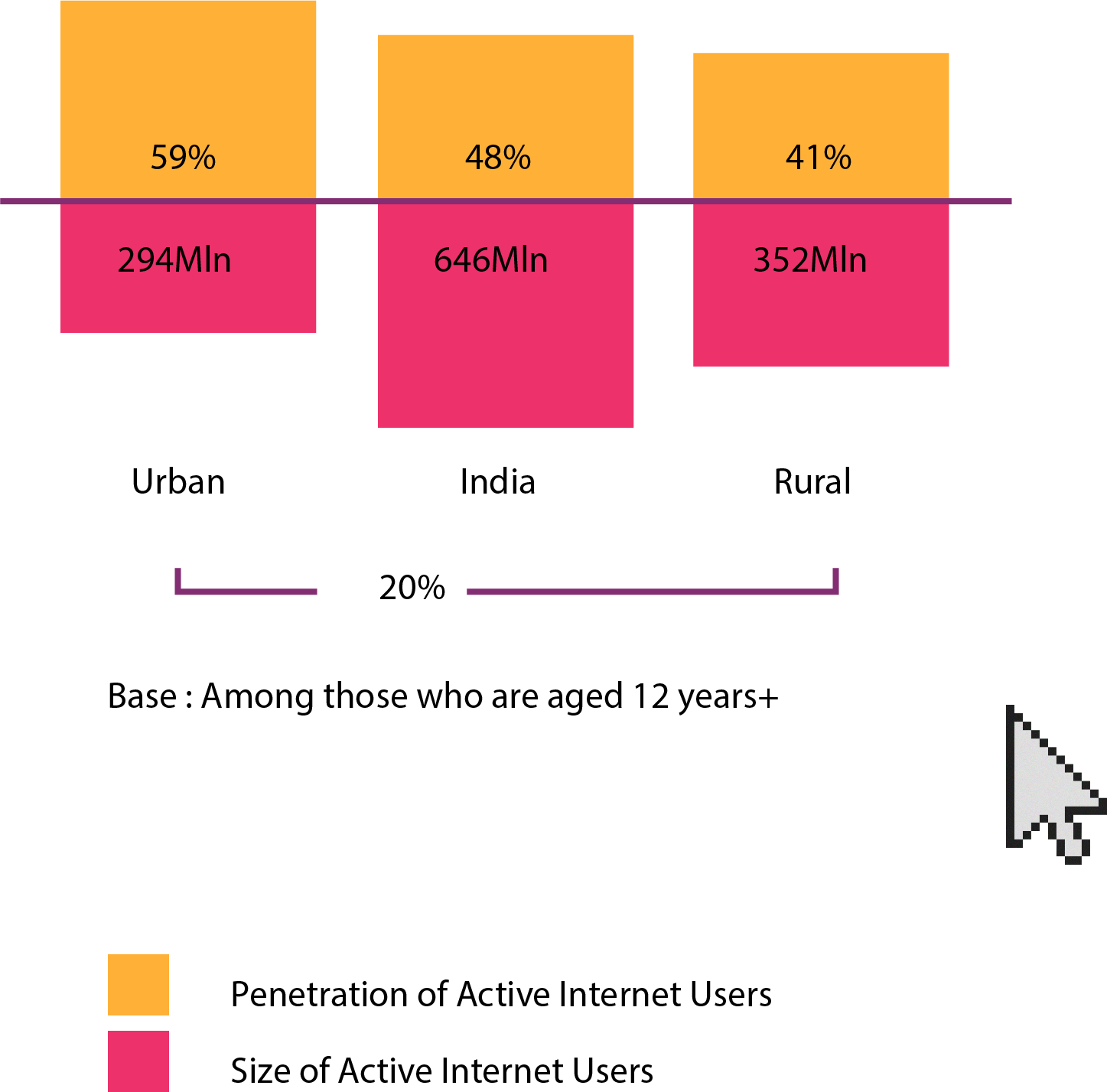
1,2 – Source: Nielsen Bharat 2.0 study, May 2022
A common sentiment we heard from several MiMis was,
There’s
a dearth of beauty content that’s relevant to her societal realities,
hence contributing little value in terms of inspiration.
What
does this translate to? A MiMi is not averse to watching beauty bloggers
talk about the latest trends. She is unlikely, however, to immediately
rush to buy that trending product she saw her favourite Instagrammer or
Bollywood celebrity use. She would rather spend a little time assessing
if it’s right for her, before making any sort of purchase decision.
Social
media is not entirely ignored, though. Instagram serves more as a means
of keeping up-to-date with the latest trends & products, without
necessarily adopting them all. YouTube, on the other hand, is her go-to
for instructional content – from how to properly blend that new
foundation, to how to turn the last dregs of her favourite lipstick into
a tinted balm, and everything in between.

Making
sense of the information available on the internet can be a little like
trying to find the perfect red lipstick – confusing, overwhelming, and
often intimidating. With over 2.5 billion (yes, that’s ‘billion’ with a
‘b’!) pieces of content on make-up tutorials alone, it’s easy to forget
what you were looking for.
The frustration at the situation was
akin to the sentiment of 'water, water everywhere and not a drop to
drink'. One MiMi lamented,
So where does she turn in order to figure out if something is right for her?

3.
Beauty begins at home
A
MiMi's first tryst with beauty is most often at her mother's dressing
table. The sense of excitement and adventure of – sneakily – trying on a
lip gloss or kajal creates the foundation of her relationship with the
category. The influence of these early experiences is perhaps why most
MiMis are inspired by their mothers, aunts and older siblings. These
early memories also shape their brand perceptions - a Lakme is
attainable and trustworthy, while a L’Oreal is aspirational and for
special occasions.
It isn’t out of the ordinary for young girls
in these markets to lean on their mothers for reliable advice when
foraying into the world of colour cosmetics and skincare. On the
contrary, the MiMi considers it a matter of pride that her mother was a
mentor along her journey.
Recognising
a brand as one that their mothers/sisters/aunts trust also plays a part
in the MiMi’s shopping list. Rather than reinventing the wheel, they
are likely to gravitate towards brands that they recognise/ are familiar
with and presume would suit their skin type and tone as well.
The
maternal influence doesn’t stop just at MiMi’s choice of brands. From a
very young age, a MiMi is made aware of how her grooming and styling
behaviours impact the way society perceives her. She looks to her mother
who has navigated these realities herself, to offer a reliable map and
balance of advice & observation whilst treading this tricky
territory.
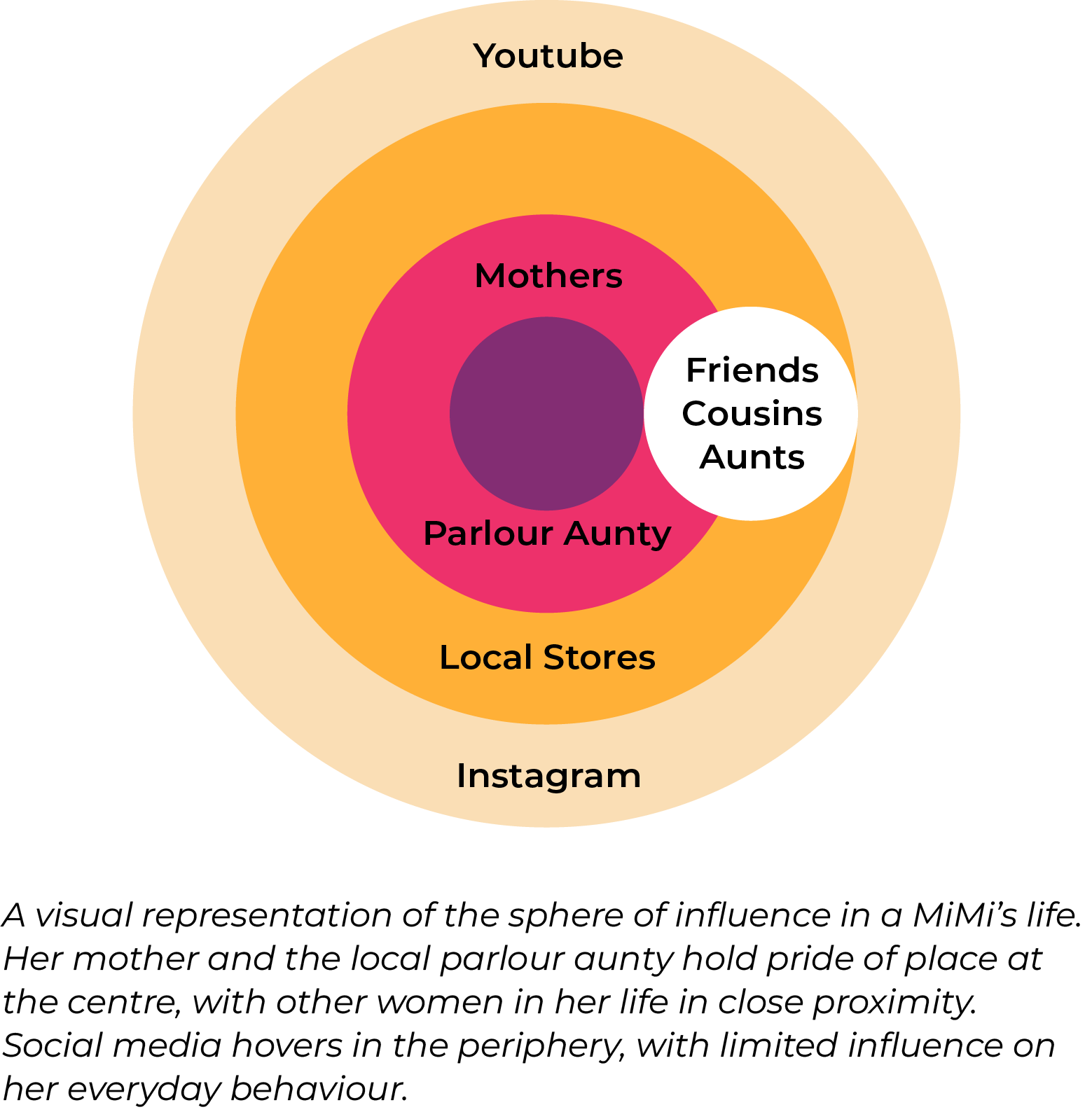
Her mother’s beauty advice and practices are just one
part of the map. She also learns by observing the many women around her –
from the little pot of kajal that has its own spot on her mother’s
dresser, to the light pink lipstick that has practically become the
neighbour aunty’s defining characteristic. The women around her all have
a signature “look,” and each of them contributes to how the MiMi
internalises the norms of make-up.
4.
The unexpected beauty influencer
The
search for guidance doesn’t stop at home. The MiMi looks to a wider
group of trusted women (and some men, too!) from their social circles
for information & inspiration. This includes those within their
household (sisters, aunts, cousins, and the like), as well as those they
consider “experts” in the beauty department.
This behaviour led
to the emergence of a rather unexpected local beauty influencer. Someone
who is regarded in the local community as an authority on the subject
of beauty and grooming, while also being relatable and understanding the
contexts of societal propriety.
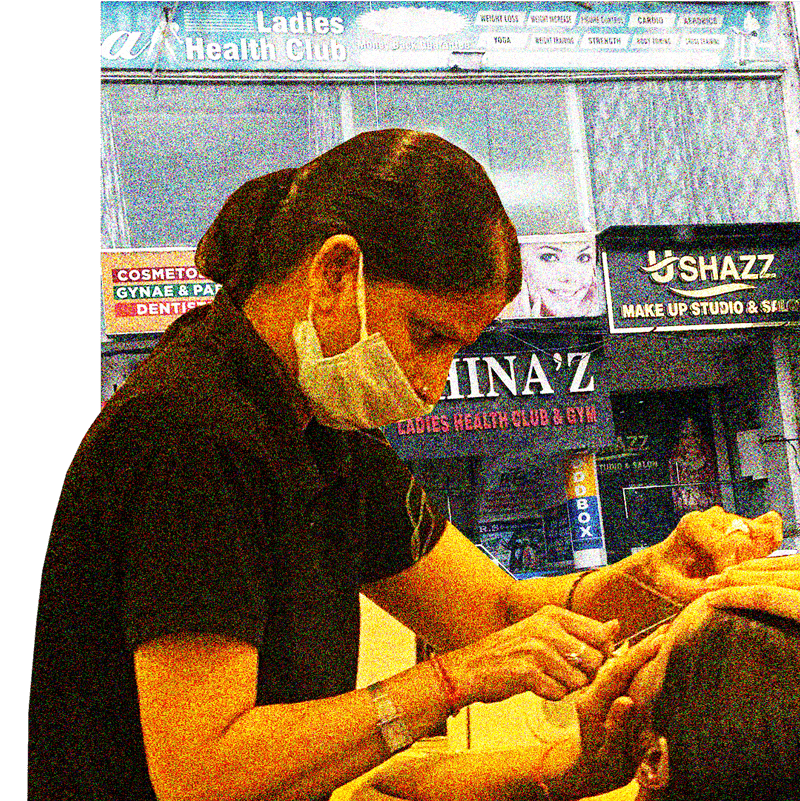
The local parlour aunty
The
neighbourhood parlour aunty is the ultimate beauty influencer in these
towns. She straddles two very important contexts – she understands
beauty better than most, and is also familiar with local societal
expectations. She is hence trusted to offer relevant & personalised
recommendations. Whether it’s how to shape her eyebrows, or what brand
of products can be relied on to not irritate her skin, the MiMi’s faith
in her parlour aunty is like a certain Bollywood star’s commitment –
unshakeable.
We realised that the sense of affection is mutual.
Speaking to a beauty parlour owner in Varanasi, it was evident that she
takes her role as a guide to these young girls very seriously. "Many
girls come to me telling me their concerns, and ask for help and
guidance,” she told us.
The parlour aunty is often the MiMi’s first interaction with grooming and styling outside of their homes. From haircuts as children to their first experiences with threading & waxing, the parlour aunty is often a constant as these girls enter adulthood and experience their first trysts with glamour. Beauty parlours being extremely hyperlocal, their clientele is largely long-term repeat customers. This allows the beautician to develop a rapport with customers.
How MiMi views beauty
Having seen the various factors & faculties influencing MiMi's perspective of the category, we wanted to better understand how each of them trickled into her beauty journey. From the shades she prefers to the looks she wants to recreate, we peered closer at the choices she makes.

1.
Occasions are binary
The
media and advertising would have one believe that makeup is highly
nuanced. "There's a look for every occasion" is a narrative commonly
perpetuated by brands and the media (especially Instagram). It would be
easy to presume that a young woman exploring beauty would hence have
multiple variants of fundamentals.
We found, however, that that was not the case.
The
MiMi’s approach to beauty is far simpler, combining self-expression
with practicality. By observing women within her social circles while
keeping social context in mind, most MiMis have grown to view make-up
looks as binary - one for everyday, and the other for special occasions.
For
everyday wear, the go-to look is minimal, with nude shades and a light
hand – think “My face, but better”. Most rely on a simple routine of
kajal/eyeliner and a tinted lip gloss to ensure they appear presentable
and well-groomed, without looking “made up”. The objective is to look as
though they’ve made some amount of effort, and not simply rolled out of
bed. It’s a social nicety, a means of showing respect to society and
its invisible guardrails. To skip this step would be a slight, construed
as disinterest or even disrespect.
It’s a whole different ball
game for special occasions. Evening events, particularly those with
higher degrees of social interaction (weddings, community functions,
etc.) call for a slightly heavier hand with makeup. In these contexts,
the effort invested in grooming and styling is considered proportional
to their emotional investment in these social relationships. To keep up
with expectations of a certain degree of glamour, it becomes vital to
break out the heavy-duty products. Now is the time for a more
substantial foundation, eye shadow, and maybe a bit of shimmer – within
reason, of course.
While the big-city Sephora connoisseur and her Raipur counterpart may be equally excited by the perfect nude lipstick, only one of them would consider it an option for a night out. Conversely, in a MiMi’s social context, while acceptable to wear a brighter/deeper lip colour for a special occasion, the same shade in the daytime would raise eyebrows.
2.
A skill best learnt formally
Between
a barrage of digital content and a labyrinth of societal expectations,
the category is understandably complex for a MiMi. Even when they do
find a look they could potentially adopt, short-form content isn’t the
ideal way for them to learn how to recreate it. 15-sec videos
aren’t quite enough to impart instruction, after all.
“Instagram
reels are too short,” laments a MiMi from Raipur. Her many attempts at
recreating looks from Instagram proved challenging because technique is
not something the format truly helps deliver. “It’s fun to watch, but I
can’t learn how to apply highlighter without step-by-step instructions.”
YouTube
videos do offer a considerable quantum of how-to content with more
detailed approaches to application techniques and methods. But these
videos lack the interaction and contextualisation that a beginner truly
needs.
These interactive programs are abundant in Middle India, with multiple beauty schools & trainers within every neighbourhood.
So
what about beauty influencers on social media? Turns out, they play a
markedly smaller role in impacting the adoption of new brands, trends
and techniques than we had initially thought. Beauty influencers
showcase multiple trends from across the globe while focusing on
aesthetic impact for digital content. The MiMi, on the other hand, seeks
social contextualisation and customisation to help her hone her skills.
What good is learning how to apply graphic eyeliner, if she can never
use it outside of her home? Most of the young women we spoke with would
not even consider adopting a trend that edgy.
Offline beauty
courses allow her to understand make-up in a far more intimate way, and
get personalised advice & attention to help ensure she wears it
well. We also spoke to the trainers at these classes to gather their
perspectives, and they echoed similar sentiments.
A primary USP of these courses is the “realness” of them all. Like the parlour aunty, these trainers bring a combination of expertise and hyperlocal societal context. The MiMi is hence able to receive inputs not just on correct technique, but also on the most suitable choice of products & shades for her needs. In this way, the home-schooling that started with her mother and aunts introducing her to beauty is formalised through these courses and training sessions.

3.
A journey of cautious exploration
The
MiMi’s overarching approach to beauty is minimal and uncomplicated. But
she is still fascinated by the category, and also cautiously excited to
try new products and experiment – within her social boundaries, of
course.
There is a certain amount of scepticism and caution that
tints these experimental buys. The MiMi values value; she isn’t about
to spend a large amount on a product she isn’t completely comfortable
with. Whether it’s the risk of skin sensitivity or a less-than-pleasant
reaction from her social circles, she is wary of the flipsides to
experimenting with new brands or products.
Minis, testers &
travel-size SKUs are a big hit with this audience when it comes to
trying a new skin ingredient or product. They allow the MiMi the
flexibility to try out a new product without committing to a
particularly large quantity of it or shelling out full price. In this
way, she can sample a new shade or formula to see if it suits her needs,
thereby intelligently fine-tuning her own signature look.
The
MiMi also tends to stick to brands that she has previously used or seen
her trusted circle of women use. She is unlikely to experiment with a
new brand, especially in the absence of a go-ahead from someone whose
opinion she values. If her routine currently includes a Lakme
moisturiser, she will look to the same brand when she wants to add a
serum to her skincare. The way she sees it, sticking to multiple
products from the same brand means that they’re more likely to pair well
together and minimise the risk of any adverse reactions.
Beyond
what the MiMi shops for, her cautious mindset also trickles down to how
she shops. Despite belonging to a generation of digital natives, she
views the multiplicity of online beauty platforms with some
apprehension.
While the e-commerce platforms do offer a wider
variety, great discounts and undeniable convenience, they lack the
reassurance that an offline purchase experience offers. Tales of
inauthentic or contaminated products, horror stories of missing prepaid
orders, and the stress of discovering that the shade you ordered doesn’t
match the picture – only to be rendered unreturnable the moment you
tried that swatch – are all looming factors that cause the MiMi to keep
the e-commerce experience at arm’s length.
The brick-and-mortar
experience offers more reassurance. She can ensure that products are
authentic and exactly what she’s looking for. After all, this is a
category where the slightest variation in shade or texture can be a
dealbreaker.
The
MiMi’s beauty shopping is also guided by the strength and importance of
interpersonal relationships. She is far more comfortable visiting her
preferred beauty retailer, often even forging a friendship with the
beauty expert or salesperson there. Building that relationship makes the
process feel less transactional. That personal interaction also allows
her to try on shades, and check for product authenticity &
shelf-life before she makes her purchase decisions. Over time, it
translates to more personalised recommendations, and may even score her
some free samples or testers. These softer benefits are considerably
more valuable to the MiMi than popular e-commerce perks like next-day
delivery.
Shopping offline also makes the entire process more
intentional, as opposed to the all-too-real risk of impulse purchases on
online platforms. For the value-conscious MiMi, visiting a store to
touch & feel the product rather than simply going from browse to
cart in a few clicks makes the experience more mindful. Her purchases
are resultingly more purposeful, and less likely to contribute to
seldom-used dressing table clutter.

Our key learnings & takeaways
As the Indian D2C ecosystem grows exponentially, metro cities are no longer the only audiences. It’s important for founders, investors & marketers alike to hence develop a deeper understanding of how behaviours vary across demographics.

Social Circles > Social media
The influencers of small-town India aren’t on Instagram with 100k followers – they’re closer home. From her mother to the neighbour ladies to the local parlour aunty, the MiMi turns to a closer, trusted circle to better understand and explore the beauty category. Word-Of-Mouth is still the strongest testimonial, and societal context & realities cannot be ignored.
Occasions Are Binary
Unlike metro messaging that celebrates various looks for the most nuanced occasions, make-up is treated in a binary fashion in small-town India. Looks are either daytime or evening/special occasion, with the distinctions & details being heavily influenced by societal norms.
Offline influence can build online adoption
The small-town Indian consumer is cautious and value-conscious. An offline purchase experience offers the flexibility to sample product shades & textures in person, as well as verify the authenticity of products before purchase.
Redesign, not repurpose
Small-town India does not actively engage or act on repurposed cosmopolitan content. For the MiMi, it is vital to communicate with context and relatability. Brands & creators need to speak to their realities, as opposed to simply adapting metro messaging.
Epilogue
It’s
exciting times ahead for the Indian startup ecosystem. The D2C sector,
in particular, is potentially building for over a billion users across
categories. For investors and founders alike, the strongest arrow in our
quiver is a deep understanding of the consumer and their needs &
wants. As TAMs expand and relevance increases, there has never been a
period of greater potential for the Indian D2C sector.
The
purpose of this research and report is to explore consumer behaviours
and triggers amongst non-metropolitan markets, as they are poised to
become a significant portion of the adoptive consumer base.